Thai Massage for Stressed and Burnt-Out Professionals
Most treatments marketed at stressed professionals promise relaxation and deliver sixty minutes that leave your nervous system exactly where it found you: alert, tense, and already composing tomorrow’s to-do list. The problem is not always the massage itself. It is that the treatment never reaches what is actually keeping you wound up.
Burnout is not tiredness you can sleep off. It is a nervous system stuck in survival mode. Cortisol and adrenaline keep cycling on a loop that surface-level treatments barely touch.
Work-related stress causes nearly half of all ill health in Britain, reports the HSE. The standard advice is to rest and disconnect. But for a nervous system locked in high alert, rest alone is not enough.
Glasgow’s professionals know this pattern well: solicitors and accountants under relentless billing pressure, architects and consultants absorbing client load, public-sector workers running services on reduced teams. The physical signs are unmistakable.
Chronically raised shoulders and a jaw that never fully unclenches. Upper traps wired tight even on a Sunday. Breathing that stays shallow all week, even at rest.
What clients describe before their first session is often the same: “I’ve had massages before and felt better for a day, then I’m straight back to where I was.” The issue is not the technique — it is that the treatment never addressed what was keeping the nervous system locked in the first place.
The tension from sustained professional stress did not build overnight. A rushed spa treatment will not shift it either.
What actually settles an overloaded nervous system is something slower and more deliberate. It needs to be structured enough to give the body a real signal to stand down. Book a session when you are ready for that kind of work.
Traditional Thai Massage for Overworked Professionals at Serendipity
Jariya Malone, head therapist at Serendipity, encounters this pattern in session after session. “I often see clients tense up the moment they lie down,” she says. “Shoulders up around their ears, jaw clenched.”
“By the end of the session, something shifts,” she adds. “They realise they’ve been holding tension they didn’t even know was there.” They book in again not because they feel pampered, but because they understand their body needed that release.
In our experience, the hardest clients to settle are rarely the ones in the most physical pain. They are the ones who have been running on adrenaline so long they have forgotten what rested feels like.
They approach the session the way they approach everything else: by trying harder. The technique works better when they stop.
Most massage venues in Glasgow — hotel spas and high-street chains included — are built around a relaxation ritual: a standard sequence repeated regardless of what walks through the door. For someone in chronic professional stress, that model falls short. It treats relaxation as a mood to be created rather than a physiological state to be reached. The result is the “better for a day” experience that brings clients to us after trying everywhere else.
That shift happens because Traditional Thai Massage works through the body rather than over it. Slow acupressure along key tension pathways, combined with assisted stretching, gives the nervous system a concrete experience of safety. This is not a verbal instruction to relax.
For burnt-out professionals whose minds have learned to override every attempt to switch off, this distinction matters. The body responds to skilled technique before the mind agrees to anything.
Book a session at Serendipity when you are ready for something that reaches where the spa day cannot.
Recommended Treatments for Burnt-Out Workers
Serendipity offers a full menu of therapeutic treatments. The following are particularly well matched to the patterns that sustained professional stress creates:
- Traditional Thai Massage — fully clothed acupressure and assisted stretching that works directly on the nervous system through slow, deliberate pressure and breath-led stretch sequences. The first choice for genuine down-regulation.
- Thai Deep Tissue Oil Massage — therapeutic oils with targeted deep pressure; reaches the structural tension that builds in the upper back and neck after long hours at a desk or in back-to-back meetings.
- Thai Aromatherapy Massage — the oil massage technique with therapeutic-grade essential oils; the scent layer adds a calming signal that deepens the nervous system’s shift from reactive to rested.
- Hot Stone Massage — basalt stones combined with massage technique; the sustained warmth helps tightly held muscles release at a depth that is hard to reach when the body is in high-alert mode.
- Swedish Massage — classic flowing strokes at soft pressure; a gentler entry point for first-time clients or sessions focused on settling the nervous system rather than deep structural work.
Getting Here Around Your Schedule
Serendipity Massage Therapy & Wellness is at 93 Hope Street, Central Chambers, Floor 1, Suite 48-50, Glasgow, G2 6LD. The studio sits at the centre of Glasgow’s professional district. Both Buchanan Street and St Enoch subway stations are within easy walking distance.
For anyone working in offices around St Vincent Street, Blythswood Square, or Sauchiehall Street, a lunchtime session is a short walk away. The concentration of law firms, financial services businesses, and consulting practices in the blocks around Hope Street means the studio is inside many clients’ lunch radius — not a commute to plan around, but a ten-minute walk.
Evening appointments are available seven days a week. Book your appointment online to lock in the time that fits, or call the studio directly on 0141 673 6630.
Why Professionals Trust Thai Massage Therapy at Serendipity
Jariya Malone developed the techniques used across every Serendipity session. Each therapist is trained to the same standard — it does not vary by practitioner or by day.
For clients arriving depleted, with little patience for unpredictable outcomes, that consistency matters. It is what makes coming back feel safe rather than a gamble.
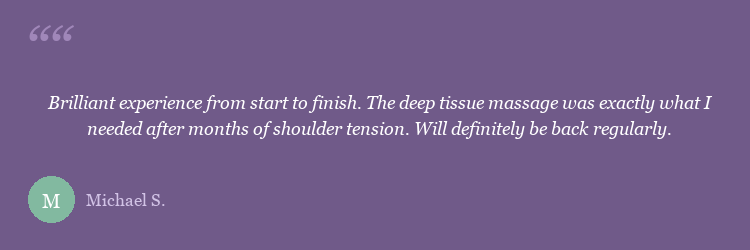
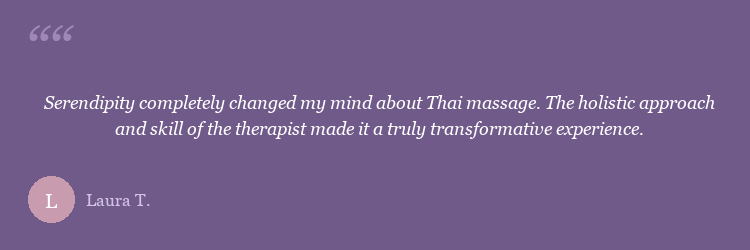
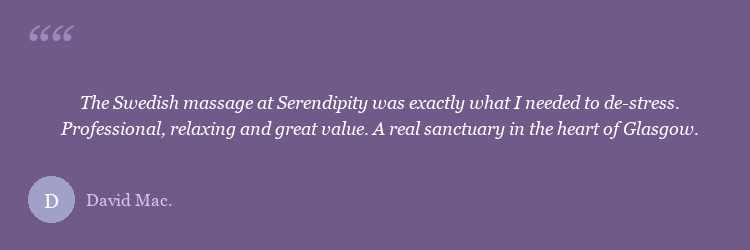
Clients returning for deep tissue sessions describe outcomes in before-and-after terms: “took time to understand what I needed and tailored the massage perfectly” (Ailsa W., 5★ verified review); “knots in my shoulders and neck, gone” (Rod M., 5★ verified review). The word that recurs most often in reviews is “professional.”
What is equally notable is what those reviews do not mention. Unlike reviews of hotel spa treatments — which linger on ambience, scent, and the softness of the robe — Serendipity’s clients write about what changed.
Whether the tension shifted. Whether they slept differently. Whether they felt noticeably different going back to work on Monday.
For burnt-out professionals making a rare investment in recovery, that word is what turns a first visit into a standing monthly appointment. Reserve your session and find out why regulars keep coming back.