Thai Massage for Drivers
Massage for drivers is most often recommended for lower back pain. At Serendipity Massage Therapy & Wellness, that is rarely the whole story.
The lower back is where discomfort surfaces, but the actual pattern runs deeper and further through the body, specific enough that a roadside stretch, however well-intentioned, never quite resolves it. Sustained seated posture builds fascial restrictions and compensation patterns that passive movement cannot release, because stretching addresses muscle length while these restrictions sit in the connective tissue and the structures surrounding the joints.
Glasgow’s taxi drivers, HGV drivers, van couriers, and private hire drivers share a recognisable physical profile. The right hip shortens through years of pedal use, loading the piriformis and gluteal complex. Sciatic-type symptoms are common as a result.
Drivers tend to describe it the same way: a dull ache in the lower back that becomes a shooting pain through the buttock and down the outside of the thigh by the fourth or fifth hour of a shift. Most put it down to “just a bad back.” The origin is the right hip, not the lumbar spine.
The phrase that comes up most in consultations is “it’s fine until I try to get out” — out of the cab, out of the van, up from the seat at the end of a run. That movement is the one that reveals how much has accumulated during the shift. Book a session and describe how your typical shift plays out.
The neck develops an asymmetry from constant shoulder checks and mirror scanning. The rotator muscles on one side work harder than the other across every shift. Forward head position and rounded shoulders from wheel posture add further strain.

Glasgow’s stop-start city centre traffic and the M8 combine to create a specific loading pattern — stationary tension followed by sustained motorway vibration, often in the same shift. Both modes compound the same structures. Routes held at the Kingston Bridge add a distinct toll — no room to shift position, engine running, the same muscles bracing under static load for extended periods at a time.
Whole-body vibration through a van or HGV seat adds another layer on top. Research puts musculoskeletal disorders among professional drivers at over 60% prevalence. Nearly 80% experience significant neck pain during their working life.
Generic back massage rarely reaches this. Most sessions address the symptom — the ache in the lower back — without working on the hip flexor dominance and piriformis tension that drive it. That is why the relief is short-lived.
Most massage businesses take a generic intake — where does it hurt, how long, how bad. Serendipity’s therapists ask which side you drive on and how long your typical shift runs. That shapes the session around your specific asymmetry rather than a standard back routine.
Why Professional Drivers Keep Coming Back for Traditional Thai Massage
Serendipity Massage Therapy & Wellness is on Hope Street in Glasgow city centre. It is close to Buchanan Street and St Enoch subway stations and central to the city’s transport routes. The studio is open seven days a week.
There is usually a slot that fits your schedule. That includes city runs, Central Belt hauls, and irregular private hire rotas.
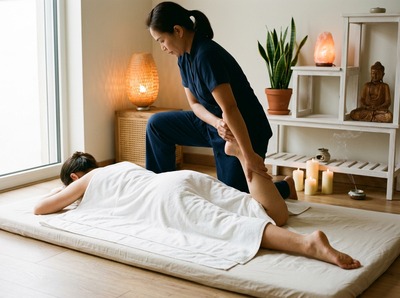
Jariya Malone, Serendipity’s head therapist, says drivers often carry tension they don’t know is there until the session starts. “I often see clients tense up the moment they lie down — shoulders up around their ears, jaw clenched,” she explains. “By the end of the session, when they realise their body has been holding tension they didn’t even know was there, something shifts.”
For drivers, that held tension sits in the right hip, the neck rotators, and the upper trapezius. These are the structures bracing hardest against vibration and unpredictable traffic across a full shift.
Drivers who have seen other therapists consistently describe the right-hip work as the element no previous session had reached — the area they had written off as normal until it was released. Book a session and your therapist will ask about your specific problem areas before any work begins.
The treatments that suit drivers best target both the asymmetry and the static load, not just the symptomatic tightness:
- Traditional Thai Massage — acupressure along specific muscle pathways, combined with assisted stretching. The therapist positions the body and applies pressure into the restriction itself — releasing hip flexors, piriformis tension, and neck rotators. Passive movement does not reach these areas. The stretching is matched to where your body actually is, not a standard range of motion.
- Thai Oil Massage — therapeutic oils with targeted deep pressure on the lower back, gluteal complex, and right-side posterior chain. A strong first choice for drivers carrying weeks of built-up muscle soreness.
- Thai Deep Tissue Oil Massage — when tension has built over months, this is the right choice. It applies sustained pressure to the posterior chain and works on chronic holding patterns more directly.
- Sports Massage — targeted recovery and injury prevention for drivers with recurring hip, knee, or back strain.
- Swedish Massage — a gentler option for nervous system recovery and better sleep. Useful for drivers on overnight or long-distance rotas.
Thai Massage Therapy for Taxi, Van and HGV Drivers in Glasgow
Serendipity is in Central Chambers, 93 Hope Street, Floor 1, Suite 48-50, Glasgow, G2 6LD. It is a short walk from Buchanan Street and St Enoch subway stations. The location is easy to reach from most parts of Glasgow at the end of a shift or on a day off.
Book online or call 0141 673 6630. If your finishing time is hard to predict, call ahead. The team will do their best to fit you in.
Every therapist at Serendipity trains to a consistent standard. The techniques were developed by Jariya Malone, and the approach stays the same regardless of which therapist you see. For drivers, that matters.
Drivers often carry a strain pattern built up over years of shifts. Consistent sessions address that pattern over time, rather than giving short-term relief that keeps cycling back.
Drivers who come in regularly report waking up without the stiffness that used to last until mid-morning, and reaching for painkillers less often after shifts. See all treatments and book when it suits your schedule.