
Why Your Face Holds Stress: Facial Massage and Head Oiling for Glasgow Desk Workers
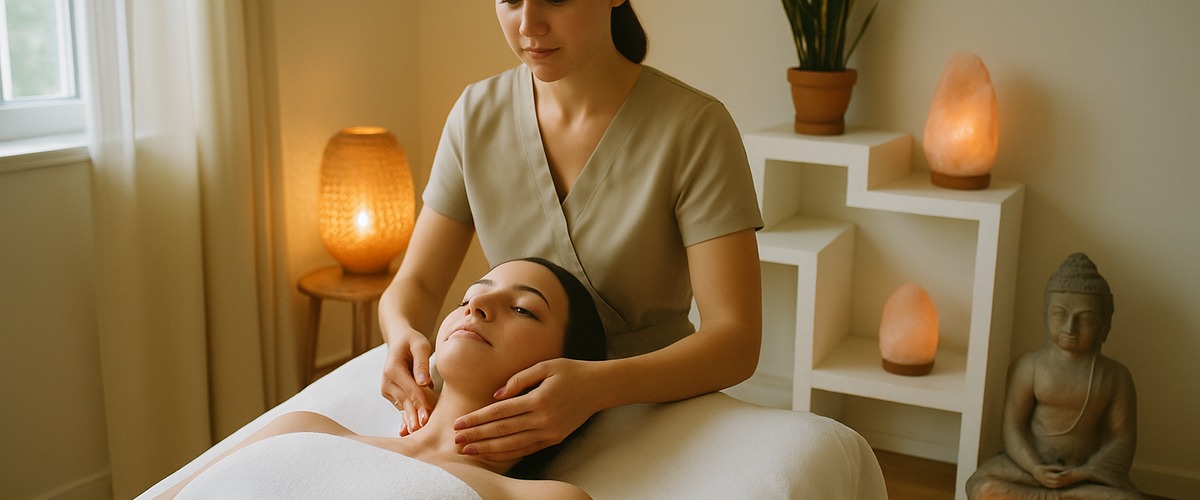
Facial Massage in Glasgow Starts With the Tension Map
By mid-afternoon, most desk workers in Glasgow’s city centre are carrying a jaw that won’t quite unclench, a furrow between the brows that hasn’t smoothed out since the last video call, and a dull tightness circling the temples. That isn’t random discomfort. It’s a predictable pattern, and it’s why facial massage in Glasgow is increasingly treated as targeted release work rather than a beauty top-up. The face and scalp hold stress in specific, mappable points: the jaw hinge, the brow and eye ring, the temples, and the base of the skull. Facial massage and head oiling work that exact map, rather than relaxing you in general.
The Masseter Brow and Temple: Where Facial Massage Finds the Knots
Three points do most of the work. The masseter, the jaw muscle running from cheekbone to jaw angle, clenches under stress and tightens further from hours of screen focus, which is the muscle behind that end-of-day jaw ache.
The orbicularis oculi, the ring of muscle circling the eye, tightens with prolonged squinting at monitors and contributes to brow furrow and eye strain. The temporalis, the fan-shaped muscle at the temple, radiates that clenching into a band of pressure that often gets mistaken for a headache building on its own.
These aren’t separate complaints. They’re one muscle-contraction tension headache pattern, spread across three points that sit within inches of each other.
The Chain Reaction: How Screen Posture Rewires Your Jaw
The pattern doesn’t start at the jaw. It starts with posture. Every inch the head drifts forward toward a screen adds roughly ten extra pounds of load onto the cervical spine, and the suboccipital muscles at the base of the skull tighten to hold the head up against that pull.

As the head’s resting position shifts, the jaw’s resting position shifts with it, and the muscles that close the jaw compensate to keep the bite aligned, which is what tips into clenching and grinding. This is the chain that makes the tension map real rather than coincidental: neck posture drives jaw tension, jaw tension drives temple and brow tension.
Left alone, that pattern rarely resolves on its own, which is why more Glasgow desk workers are choosing to book a facial massage session before it settles into a recurring headache rather than after.
Head Oiling as Massage for Jaw and Scalp Tension
Facial massage releases the front of the map. Head oiling picks up where it stops.
Warm therapeutic oil worked into the scalp and hairline extends release into the crown and the base of the skull, exactly where that suboccipital tension actually originates, and a scalp massage stress hormone study found measurable drops in cortisol and norepinephrine alongside a shift toward parasympathetic, rest-and-digest activity.
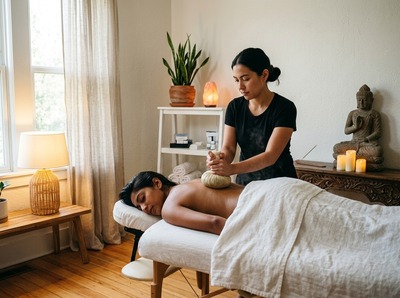
For anyone working long hours at a desk in Glasgow, Scotland, that combination, facial release at the front and oiling at the back of the head, closes the loop the posture chain opens. Head and hair oiling and Thai head massage are built around exactly that pairing.
The Treatment Room Evidence Behind the Face and Scalp Tension Map
Jariya Malone, Serendipity’s head therapist, sees the same moment repeat with new clients. As she puts it, clients often tense up the second they lie down: shoulders up around their ears, jaw clenched, and by the end of the session, when they realise their body had been holding tension they didn’t know was there, something shifts. That’s the tension map showing itself in real time.
It also lines up with what clients tell us about other tightness: reviewers describe therapists who “concentrated on problem areas” rather than running a generic routine, and the same posture-driven strain that shows up from golf, construction work or long shifts on your feet shows up just as reliably from a desk. Facial treatment is already one of Serendipity’s most-loved bookings, one client left a review after “a great tailored luxury facial here with Jariya,” which makes head oiling a natural next step rather than an unfamiliar add-on.
If you’d like the full picture, you can book your session online and mention where you’re holding tension.
Reading Your Own Tension Map Between Sessions
Before you book, run a quick check. Press along the jaw hinge just in front of your ear; tenderness there means the masseter is already overworked. Look at your brow in a mirror at the end of the day; a furrow that wasn’t there this morning is the orbicularis oculi holding stress.
Roll your shoulders back and notice whether your head follows or stays forward, that’s the posture piece of the chain. For most people working in Glasgow’s financial district around Hope Street, a session every two to four weeks holds this pattern down once it’s been properly released, with weekly visits during particularly heavy stretches.
This isn’t pampering. It’s addressing, at the source, the specific points desk work loads tension into, which is the whole reason the tension map matters more than a generic relaxation treatment. Our full range of treatments covers the rest of the pattern if your shoulders and neck need the same attention as your face.