
The Best Stretches for Lower Back Tightness at Home: Why Your Hips Matter Too
The Best Stretches for Lower Back Tightness Start at Your Hips
The most effective stretches for lower back tightness are the ones that open your hip flexors first, then your lower back, because tight hips are usually what is actually pulling your spine out of a comfortable resting position. If you’ve tried the usual list of lower back stretches and the tightness keeps coming back within a day, this is often why.
Sitting keeps your hip flexors, including the psoas muscle that attaches directly onto your lumbar spine, in a shortened position for hours at a time. That shortening pulls the top of your pelvis forward into what’s called an anterior pelvic tilt, and your lower back then has to arch to compensate. This is the actual mechanism behind most everyday lower back tightness, not a weak or damaged back.
A 2020 study published in Musculoskeletal Science and Practice measured passive hip extension in 144 adults and found that people who sat the most and moved the least had around 6 degrees less hip extension than people who sat least and moved most (Boukabache et al., 2020). Six degrees doesn’t sound like much, until you realise it is tugging your pelvis into that same forward tilt every time you stand up.
Here is where the standard advice misses the point. Almost every “10-minute routine for a tight lower back” opens with a move that stretches the lumbar erectors — the long muscles running either side of your spine. In our experience, that is the wrong first move for a desk worker. Those erectors are usually not short at all. They are working overtime to stabilise a pelvis that tight hip flexors have already tipped forward. Lengthen them on their own and you take away the brace without touching the cause, which is why people describe feeling looser for an hour and then noticeably less stable, or tighter, by the evening.
Jariya Malone, Serendipity’s head therapist, sees this order-of-operations problem constantly — and not only in backs. A runner came to her mid-training cycle with calf tightness that was changing their stride. The fix was never the calf. It was the fascial restrictions and compensation patterns their body had built elsewhere, and once those released, the calf stopped complaining on its own.
Lower back tightness after a day at a desk works the same way. The spine is rarely the true source: it’s usually just the last link in the chain. We’ve seen clients in our Glasgow city-centre studio who had been diligently doing back stretches every morning for months, wondering why nothing held. Their backs were fine. Their hips had been folded at 90 degrees since half eight that morning.
That’s why the five stretches below open the hip flexors first and ask less of the lower back directly. If your tightness has been building for months rather than days, it’s often faster to book a session online and have a therapist assess the actual pattern than to keep guessing at home.
Half-Kneeling Hip Flexor Stretch
Kneel on your right knee with your left foot flat on the floor in front, hips stacked directly under your ribs rather than tipped back. Gently tuck your pelvis under and shift your weight forward until you feel a stretch along the front of your right hip, then hold for 30 to 45 seconds before switching sides. This move works directly on the iliopsoas, the deep hip flexor that attaches onto the lumbar spine, which is why it often does more for lower back tightness than any stretch aimed at the back itself.
90/90 Hip Stretch
Sit on the floor with your front leg bent at 90 degrees in front of you and your back leg bent at 90 degrees behind you, then square your chest over the front shin and hold for 30 seconds before rotating to switch legs. This improves range of motion in both hip rotations that most sitting jobs never touch, giving your lower back room to move instead of absorbing load it wasn’t built for. Keep your spine tall rather than collapsing forward, since the stretch should be felt in the hip, not the back.
Knee to Chest Stretch for a Tight Lower Back
Lie on your back with both knees bent, then pull one knee gently toward your chest while keeping the opposite foot flat on the floor and your lower back relaxed into the mat. Hold for 20 to 30 seconds each side, breathing steadily rather than bracing. This one works best after the hip flexor stretches above, since a lower back that’s already free of pelvic tension will release into the movement instead of fighting it.
Cat-Cow Spinal Flow
Come onto your hands and knees, then alternate between arching your back and dropping your belly toward the floor as you inhale, and rounding your spine toward the ceiling as you exhale. Move slowly through 8 to 10 rounds, letting the motion come from your whole spine rather than just your lower back. It’s a gentle way to keep the joints between each vertebra moving, which matters as much as the stretching itself once tightness has built up over weeks.
How to Loosen a Tight Lower Back With One Combined Move
Kneel and sit back onto your heels with your arms stretched forward into child’s pose, then let your hips sink slightly toward one side to deepen the stretch through that hip flexor while your lower back lengthens at the same time. Hold for 45 to 60 seconds each side, and let your breath do more of the work than your muscles. This is the closest thing to a shortcut for tight lower back muscles, because it treats the hip and the spine together instead of picking one.
These five moves loosen the everyday tightness that builds from a desk job in Glasgow’s city centre, but they work best done daily for two to three weeks rather than once. If a hip flexor stretch keeps turning into a lower back stretch no matter how careful your form is, that’s usually a sign the muscle needs hands-on release, and it might be worth a booked session rather than more solo guessing.
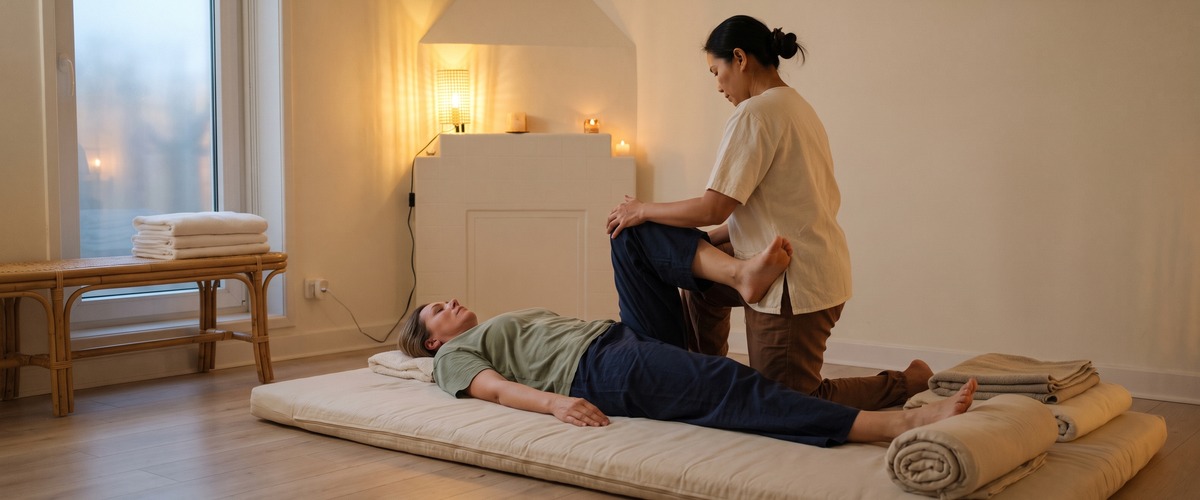
Serendipity’s traditional Thai massage uses the same assisted stretching principle, with a trained therapist guiding the movement instead of your own tired hip flexors doing all the work. Jariya often tells clients that one session brings real relief, but changing a pattern built up over months at a desk takes repetition, the same logic behind stretching daily instead of occasionally. When the muscle fibres are too knotted for stretching to reach on their own, a Thai deep tissue oil massage can speed that process along.
Give the hip flexor work the same attention as the classic lower back stretches, and most everyday tightness eases within two to three weeks. If it doesn’t, that’s useful information too: it usually means the pattern needs a therapist’s hands, not just more stretching.
Found this useful? Add serendipitymassage.co.uk as a preferred source on Google so our latest guides show up first for you in Search and AI Overviews.