
Thai massage vs Swedish massage: what your body actually gets
Thai massage vs Swedish massage: two mechanisms not two pressure levels
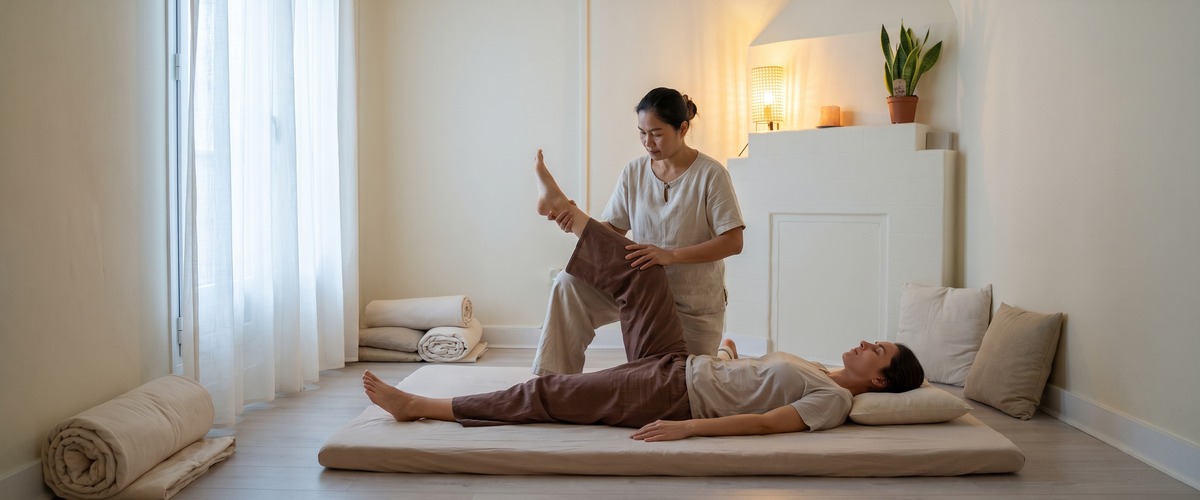
Thai massage and Swedish massage do not sit on one scale running from gentle to deep. Thai massage works through passive joint mobilisation: a therapist moves your limbs and spine through assisted, yoga-like stretches while your own muscles stay relaxed and uninvolved. Swedish massage works through active kneading: a therapist’s hands work directly into your muscle tissue with flowing, hands-on strokes.
Most comparison guides frame the choice as “how much pressure do you want”, and that misses the point. The real question is which pathway your body needs: opened joints and lengthened tissue, or worked and released muscle.
Get that wrong and you can book a lovely hour that does nothing for the problem that sent you looking.
How traditional Thai massage moves your joints instead of kneading your muscles
Traditional Thai massage combines acupressure along the body’s sen energy lines with the assisted stretching that gives the treatment its yoga-like feel. The tradition dates back centuries in Thailand, where it is known as nuad thai, and UNESCO added it to its intangible cultural heritage list in 2019.
Every stretch is guided, so you do not do the work. Your body simply receives it, which is what makes the pathway passive rather than active. Because your own muscles never fire to hold the position, the joint can be taken through range without the guarding that kicks in when you stretch yourself.
Jariya Malone, Serendipity’s head therapist, sees this mechanism play out in her own clients. She once worked with someone convinced they needed shoulder surgery.
Six weeks of consistent Thai massage, targeting the rotator cuff, neck and years of desk-built tension patterns, brought their full range of motion back. They cancelled the surgeon’s appointment.
The same pathway shows up in performance work, where nobody expects it. A runner came to Jariya mid training cycle with calf tightness that had started to alter their gait. Two sessions on the fascial restrictions and the compensation patterns their body had built around them, and they took a personal best off their 10K time. They had booked for recovery and got a faster race out of it, which is what happens when the restriction was mechanical all along.
That is the mechanism behind Thai massage every time: passive joint mobilisation, not active muscle work. It answers a different question than Swedish massage does, which is exactly why the two are not interchangeable.
If tight joints or restricted movement are what is holding you back, you can book a Thai massage session and let a therapist assess where you have lost range.
What Swedish massage does that Thai massage doesn’t
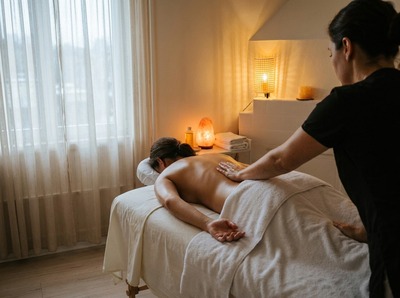
Swedish massage works in the opposite direction. A therapist’s hands do the moving through effleurage, long gliding strokes that warm the tissue, and petrissage, the kneading and squeezing that reaches into the muscle belly itself.
You lie still throughout. The outcome is looser, better circulated muscle tissue rather than a wider range of motion.
Here is the part the comparison articles leave out, and it cuts against the usual story that Thai is the therapeutic one and Swedish is the soft option. In a randomised controlled trial of 140 adults aged 60 and over with chronic low back pain, Swedish massage with aromatic ginger oil beat traditional Thai massage on both pain and disability, in the short term and the long term, at p=0.04.
That is one condition, one age group, and one specific oil, so it does not settle the argument for everyone. In our experience it supports the mechanism point rather than undermining it: when the problem sits in the tissue itself, tissue-level work is the shorter route, and no amount of assisted stretching substitutes for it.
One first-time client at Serendipity described the result simply after his first Swedish massage. The knots in his shoulders and neck were gone by the time he left.
Compare that with clients who come in for muscle strain rather than stiffness. A construction worker whose shoulders and neck were sore from months of manual labour had a Deep Tissue Thai Oil Massage with Jariya, a firmer, oil-based version of the same technique, and it “worked wonders”.
Stephen M., carrying back and shoulder tightness from golf, said the same treatment “loosened the tension he’d been carrying” until he left feeling much better.
Which one actually fixes your problem
When you are weighing up Thai versus Swedish massage, the mechanism question settles it faster than any pressure scale can. If your problem is a joint that does not move the way it used to, a stiff hip from sitting at a desk all day, or the reduced range of motion that comes with age or an old injury, Thai massage’s stretching pathway is doing the work.
If your problem is muscle tension itself, the tightness that builds across your shoulders after a week hunched over a screen, Swedish massage’s kneading gets there faster.
Sometimes the problem is neither joint nor muscle on its own. A shift worker came to Serendipity with sleep that was fragmented and never restorative. What changed it was not one treatment but a rhythm: a session every two weeks, with noticeably deeper sleep inside a month. We have seen that pattern often enough to say it plainly, that once the pathway is right, the interval between sessions does more than the pressure inside them.
At Serendipity Massage Therapy & Wellness on Hope Street in Glasgow city centre, Jariya Malone’s team is trained to spot which pathway a client needs, rather than defaulting to whichever treatment happens to be booked most that week. Ailsa W., a regular client, put it well: Jariya “takes time to understand what you need and tailors the massage perfectly”.
Not sure which pathway suits you? Book a session and mention what is bothering you when you arrive, and the team will steer you toward the right one.
Should a first timer book Thai or Swedish massage first?
This is the question people ask most online, usually alongside two others: which one hurts, and what am I expected to wear. Most first bookings here come through a friend’s recommendation or a first-visit offer, so the stakes feel higher than they are.
Both treatments work for a beginner. Swedish massage is the easier introduction if you want to lie still and let someone else do all the moving.
Thai massage suits a first timer just as well, because every stretch is set to the range you have today, not the range you think you ought to have.
Cost rarely decides it. At Serendipity, Traditional Thai Massage and Swedish Massage are priced the same for the same session length, because both use the same amount of trained therapist time.
Oil-based treatments sit a little higher. So the choice comes back to the mechanism, not the bill.
You are not choosing once and for good, either. Plenty of clients alternate: joint work one visit, muscle work the next, sometimes both inside a single session.
The pattern usually settles itself after two visits, once you have felt the difference between a released joint and a released muscle.
Glasgow’s spa roundups tend to file massage somewhere between a facial and a glass of fizz, and that framing is exactly why people wait until their neck seizes before they book anything. For the people working around Blythswood Square and St Vincent Street, Serendipity is a few minutes up from Central Station and a short walk from Buchanan Street subway, which makes a session closer to maintenance than pampering: something you schedule before the tension builds, not after.
Why Thai massage can feel more intense than Swedish massage
Thai massage can feel more intense than Swedish massage, but that is a function of stretch depth, not pain. A passive stretch takes your joints toward their comfortable end range, which can feel unfamiliar the first time even though nothing is being forced.
Swedish massage is generally gentler unless you specifically ask for firm, deep tissue pressure.
Jariya describes clients arriving convinced Thai massage is just stretching. Once she shows them how the acupressure work is targeting specific tension patterns in the neck and shoulders, releasing restrictions they have held for years, they understand it as therapeutic work rather than relaxation theatre.
Pressure applied without reading what the tissue needs wastes the session, and consistency of technique matters far more than how hard someone pushes. That holds true for both treatments, and it is the difference between a massage that does something and one that simply felt nice for an hour.
The two treatments differ in what you wear, too. Traditional Thai massage is done fully clothed in loose, comfortable clothing that gives you room to move through the stretches.
Swedish massage is done on a table, partially draped under a sheet, so you undress to whatever level suits you.
Thai massage vs Swedish massage was never really a question of which is better. They solve different problems through different mechanisms, joints versus muscle, and the right one depends on which pathway your body is asking for right now.
If you are still unsure, book your appointment online and tell the team what is bothering you, and they will match the treatment to the mechanism, not the other way round.
Found this useful? Add serendipitymassage.co.uk as a preferred source on Google so our latest guides show up first for you in Search and AI Overviews.