
Jaw and shoulder tension: why stress clenches both together
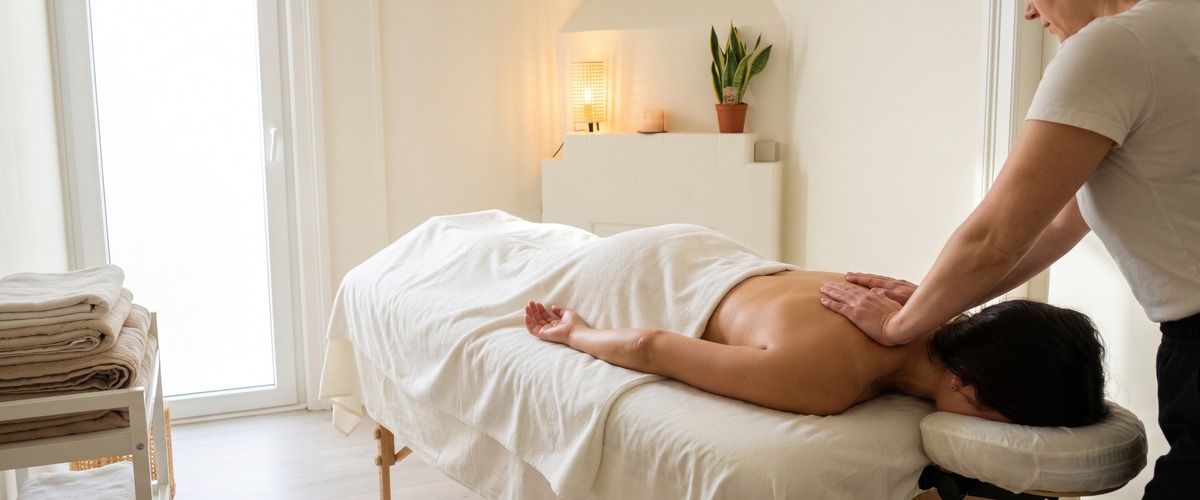
Jaw and shoulder tension: why they clench together as one pattern
Jaw and shoulder tension rise and fall together for a simple reason: they run on the same nerve line, not because stress just happens to land in two places at once. Your trapezius — the broad muscle across your upper back and shoulders — and your masseter — the muscle at the corner of your jaw that does the clenching — both feed into the very same point at the base of your brainstem.
When that shared point picks up a stress signal, it can’t tell a shoulder problem from a jaw problem. It tightens both, in the same order, every single time.
That’s the exact pattern our therapists watch unfold on the table, and it’s the part most stress-and-tension articles miss entirely. The usual advice treats a clenched jaw and tight shoulders as two different problems needing two different fixes — a jaw stretch here, a shoulder roll there. But if the two truly run on one pathway, treating them separately only ever deals with half the picture.
If you recognise the pattern already, you can book a session online with one of our therapists rather than keep managing the two ends of it separately.
The trapezius-to-masseter pathway behind stress and muscle tension
The shared junction has a name. It is the trigeminocervical nucleus, a relay point low in the brainstem where sensory nerves from your jaw and face, carried by the trigeminal nerve, converge with sensory nerves from the top three vertebrae of your neck. Research on the trigeminal nerve’s cervical convergence shows the overlap is so complete that the brain often cannot tell which territory a signal came from, jaw or neck, so tension in one reliably shows up in the other.
The muscles themselves work the same way. Your trapezius runs up through your neck to the muscles at the base of your skull — and those muscles have a hand in where your jaw naturally rests.
Keep the trapezius tight long enough — through stress, or hours hunched at a desk — and the jaw follows suit. Clench the jaw long enough, and that pull travels straight back down into the shoulders.
Why stress makes your jaw and shoulders tense at once
Stress switches on your body’s fight-or-flight response and its hormonal stress system — the one that floods you with cortisol and puts the muscles holding your posture on standby to brace. The trapezius and masseter are exactly that kind of muscle, built to brace, which is why they’re first to react. Ongoing jaw pain — stiffness or aching around the jaw joint and muscles — is one of the most common causes of persistent facial pain, and more often than not, stress is the real trigger, not the jaw itself.
It’s also why a tension headache so often starts at the base of the skull, rather than in the jaw or shoulder themselves. Ongoing tightness in the trapezius pulls on the muscles anchoring your skull, and because those nerves lead back to the same junction as your face, the pain shows up as a headache that wraps round toward the temples.
What this looks like on the massage table
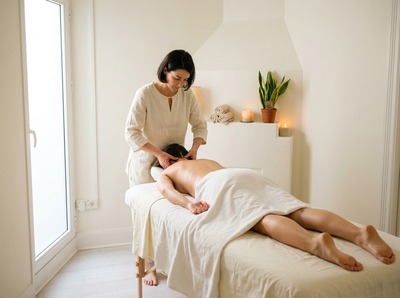
Jariya sees clients tense the moment they lie down — shoulders creeping up around their ears, jaw already clenched before she’s even begun. By the end of a session, when someone realises just how much tension their body had been carrying without them noticing, something shifts. That’s usually what brings them back.
Real client feedback bears this out. One recent review describes months of sore neck and shoulders from manual work finally easing after a deep tissue Thai Oil Massage, a treatment combining therapeutic oils with flowing strokes and targeted pressure. Another puts it more simply: knots in the shoulders and neck, gone.
That kind of deep, targeted pressure is the point. A Thai massage in Glasgow City Centre from Serendipity Massage Therapy is built around tailoring pressure to where a client’s specific tension pattern sits, not a generic full-body routine. Traditional Thai Massage works the sen lines running through the neck and shoulders with acupressure and assisted stretching, while Thai Head Massage focuses specifically on the scalp, neck and upper shoulder junction where the trapezius-to-jaw pattern actually lives.
Breaking the cycle needs more than one session
The common advice treats massage as a treat you book when life gets hectic. What we actually see on the table tells a different story: the same trapezius-to-masseter pattern shows up whether someone’s stressed today or has been stressed for six months — just more deeply set in the longer it’s been building. Treating it once eases things for a few days.
Weekly sessions for the first month, easing to fortnightly once things settle, are what stop the pattern building back up between visits. That matters most if you’re working long hours around Glasgow City Centre, where a desk job and a stressful commute through the financial district do exactly the same thing to your jaw and shoulders as any other stress response.
If that sounds familiar, it is worth booking your appointment before the pattern becomes the default rather than the exception. You can also browse the full range of treatments if you are unsure which one fits your particular pattern.
The jaw and shoulders were never two separate stress symptoms. They clench together because the nerve pathway connecting them leaves them no other choice — and understanding that is exactly what makes treating both, together and regularly, worth doing.
Found this useful? Add serendipitymassage.co.uk as a preferred source on Google so our latest guides show up first for you in Search and AI Overviews.