
Sleep and muscle recovery: what your body actually repairs overnight
The idea that “more sleep equals more recovery” is only half true. What actually rebuilds muscle overnight is not the number of hours you spend in bed, but whether you reach slow-wave sleep, the deep stage where growth hormone is released in concentrated pulses rather than a steady drip through the night. Up to 70% of your day’s total growth hormone secretion happens in that first deep sleep cycle, and growth hormone is what triggers the protein synthesis your muscles need to actually rebuild after training.
Here’s the part most advice on sleep and muscle recovery misses. Two people can train the same way, eat the same way, and still come away with completely different results — because one of them reaches deep, uninterrupted sleep, and the other keeps drifting back up out of it.
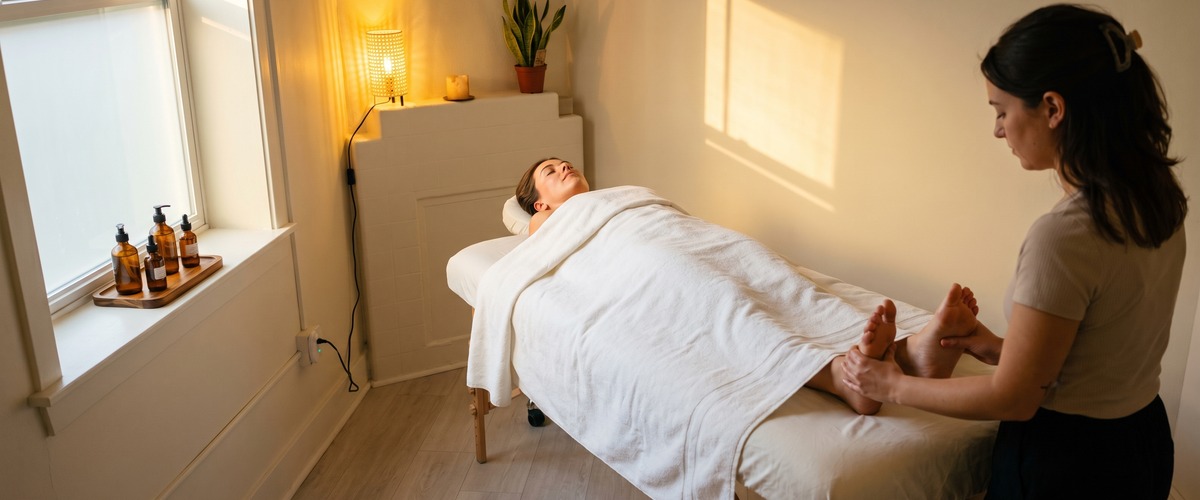
At Serendipity Massage Therapy & Wellness in Glasgow, we see this constantly in clients who train hard but still wake up tight. You can book a session online to work out whether tension itself is what’s keeping your sleep fragmented in the first place.
Sleep and muscle recovery: what your body repairs overnight
Muscle recovery doesn’t happen evenly across eight hours in bed. Most of it happens early in the night, driven by your body’s own hormones. That’s why the quality of your first sleep cycle matters more than the total hours you clock up.
What overnight muscle repair actually looks like
During slow-wave sleep, the deepest stage of non-REM sleep, your brain waves slow right down. Your body then shifts into active repair mode.
Growth hormone spikes here, and it triggers IGF-1, insulin-like growth factor 1. That is one of the strongest known drivers of muscle protein synthesis. Together they switch on myofibrillar protein synthesis, the process that rebuilds the actual working fibres inside your muscles after training breaks them down.
This is what actually powers overnight muscle repair. It isn’t passive — it’s a hormonal process that needs an unbroken stretch of deep sleep to do its job properly.
Which is exactly why two identical days of training can leave you with very different results, depending on what happens once the lights go out.
How poor sleep affects muscle recovery
A 2020 sleep restriction study in healthy young men, published in The Journal of Physiology, found something striking. Five nights of 4-hour sleep cut myofibrillar protein synthesis by around 18% compared with normal 8-hour sleep.
Pushing harder in training on those short nights only partly made up the difference. No amount of extra effort in the gym could replace the sleep that was lost.
Cut your sleep short, and your stress hormone stays high while the hormone that fuels repair drops away. Inflammation creeps up too. Together, that tips your body into a state that works against the very repair your muscles are trying to do.
It also explains why sleep loss is linked to injury, not just soreness. One study of teenage athletes found those sleeping under 8 hours a night were 1.7 times more likely to pick up a sports injury than those getting a full night.
Why sleep quality is a recovery tool not an afterthought
Most people treat sleep as something that just happens to them, and massage as a treat for afterwards.
Jariya Malone, Serendipity’s head therapist, sees the opposite pattern in her clients time and again. She remembers a shift worker who came to her with sleep that felt broken and unrefreshing, no matter how many hours they clocked up.

They settled into a steady rhythm of massage every two weeks, and within a month their sleep had noticeably deepened. Not because the massage itself was restful — but because it calmed a nervous system that had been too wound up to drop into deep sleep at all.
That’s the pattern worth paying attention to. The relaxation you feel on the table isn’t really the point.
The real work happens afterwards — once your nervous system settles and your body can finally reach the stage of sleep where recovery actually gets done.
For anyone training regularly around Glasgow’s West End or the city centre, a Thai Deep Tissue Oil Massage targets the exact tension patterns that keep people tossing and half-waking through the night. Clients who prefer a gentler, flowing approach often find a Swedish massage session does the same job through lighter, longer strokes.
Protecting the sleep window that actually repairs muscle
You don’t need a perfect eight hours. You need one unbroken first cycle. Which means a few simple things matter more than most training plans give credit for.
- Keep a steady bedtime — your first deep sleep cycle arrives earliest when your body isn’t fighting a shifted schedule
- Skip late, heavy caffeine, which pushes back the point where deep sleep begins
- Treat muscle tension as a sleep problem, not just a training one — tight shoulders and a restless lower back are common reasons people surface out of deep sleep
The takeaway
Muscle recovery isn’t spread evenly across the night — it’s packed into a window during deep sleep, driven by your body’s own hormones. Break up that window, and you can undercut weeks of good training and clean eating without ever knowing why your progress has stalled.
If tension is what keeps you from settling into that window, that’s a fixable problem, not a training problem. Book your session online and let’s find out what’s really keeping your sleep, and your recovery, from working the way it should.
Found this useful? Add serendipitymassage.co.uk as a preferred source on Google so our latest guides show up first for you in Search and AI Overviews.