
Piping Live! and the Worlds 2026: Why Pipers and Drummers Are Among the Most Injury-Prone Musicians We Treat

Pipers and drummers turn up at Serendipity with the same pattern every August. One shoulder locked solid, a forearm that will not fully straighten, a neck that has stopped turning past centre. That happens because piping and pipe band drumming load the body in ways few other instruments do: sustained, static shoulder holding for pipers and repetitive gripping and impact for drummers, and Glasgow’s Piping Live! and the World Pipe Band Championships compress a season’s worth of playing into one relentless week.
Piping Live! runs from 9 to 15 August in 2026. The World Pipe Band Championships close the week at Glasgow Green on the 14th and 15th.
For that week, bands and soloists move between venues across the city centre playing set after set. There is often barely enough time between them to eat, let alone recover. What we see in the treatment room during that fortnight is less about relaxation and more about damage control.
The packed schedule is what turns ordinary overuse into real pain by midweek. Knowing which structures take the strain matters more here than another generic festival guide. So does knowing what actually eases them between sets.
Why Pipers and Drummers Are the Most Injury-Prone Musicians We See
Most instruments ask the body to move. The bagpipe asks the chanter arm to hold still, raised and slightly turned, for the full length of every tune. That is a static hold rather than a moving muscle action, and static work tires a shoulder faster than most people expect.
Then add the weight of the drones across the same shoulder. Add the pressure needed to keep the bag full, and the sheer number of tunes played across a week like this. The strain builds daily rather than resetting overnight.
A pilot study of bagpipers found around 90% reported playing-related pain, concentrated in the ipsilateral shoulder and forearm. On average, the discomfort lasted more than three hours after a session ended.
Drummers carry a different load, and it is just as punishing. Controlling the sticks needs a repetitive gripping action. A snare harness then bears down across the shoulders and neck while marching, which builds its own overuse pattern.
Research across professional musicians consistently finds the neck and shoulders are the most affected areas. Drummers specifically report high rates of neck, forearm and wrist pain, and it is worst during marching sets rather than static rehearsal.
Playing this week and already feeling it? Book your session today and we will work the areas the instrument actually loads.
Sports Massage for Pipe Band Season
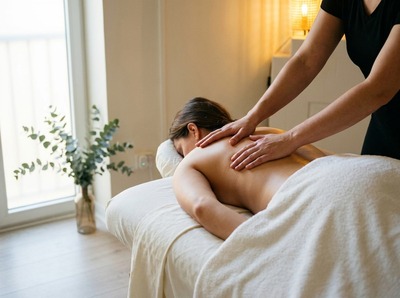
This is exactly the load sports massage was built for. It is targeted and outcome-focused, aimed at restoring range of motion and easing overuse strain rather than simple relaxation.
At Serendipity we treat pipers and drummers the same way we treat any athlete mid-season. We work the specific muscle groups the instrument overloads, not a generic full-body routine.
Jariya Malone has seen this exact pattern outside the festival too. One client was convinced they needed shoulder surgery. Instead they spent six weeks in consistent Thai Oil Massage, releasing the rotator cuff and the tension built up from years of repetitive arm positioning at a desk. Their range of motion came back and they cancelled the surgeon’s appointment.
A pipe band’s chanter arm builds a strikingly similar restriction. The difference is that it takes days rather than years, because the arm holds a near identical position for hours across a single festival week.
The common industry line is that massage is a treat you book once things get hectic. Jariya’s take runs the opposite way. It is preventive maintenance, and the goal with festival week is to stay ahead of the tension rather than chase it once a shoulder has locked.
That is why we tell competing pipers and drummers to book in before the week starts. Not after they are already limping through a set.
How the Chanter Arm and Drone Load Strain the Shoulder
The muscles doing the most work in piping are the rotator cuff and upper trapezius. Both are built for movement and recovery, not for holding a fixed position for a whole medley. When those muscles cannot relax between tunes, tension builds layer on layer across a performance day.
By the middle of Piping Live!, that shoulder often feels less like muscle and more like a solid block. Deep tissue Thai oil massage uses sustained, deeper pressure into the muscle and the fascia around it. That is usually what shifts it, rather than a lighter relaxation treatment.
Why Drummers Carry It in the Neck and Wrists
Pipe band drummers add a marching harness to a repetitive gripping action. That puts load through the neck, forearm and wrist all at once.
Studies of drummers have found the neck and lower back among the most affected areas. Wrist and hand pain is reported by the large majority of players, specifically during marching, or “battery”, performances.
A weighted harness plus constant small, forceful hand movements is a repetitive strain pattern, not a single acute injury. That is why it creeps up gradually across a festival week rather than announcing itself in one dramatic moment. By Thursday or Friday, many drummers are playing through a forearm that has been sore for days.
What Stretches Help Between Sets at Piping Live!
None of this needs a full warm-up routine backstage. A few short, targeted stretches between sets are usually enough to stop tension stacking up across a long day.
- Cross-body shoulder stretch. Bring the playing-side arm across the chest and hold gently for 20 to 30 seconds. It eases the rotator cuff and upper trapezius out of the fixed chanter position.
- Neck side-bend, away from the drone side. Tilt the head gently towards the opposite shoulder and hold. This releases the muscles that carry the drone weight all day.
- Forearm flexor and extensor stretch. Straighten the playing arm. Gently pull the fingers back, then down at the wrist, holding each direction for 20 seconds. It counters the constant gripping in both piping and drumming.
- Thoracic rotation. Seated, rotate gently through the upper back in each direction. This undoes the forward-hunched posture most players fall into over a long set.
These are maintenance, not treatment. If a shoulder or forearm is still sore the next morning, that is the signal it needs proper hands-on work rather than another stretch.
For anyone competing across the full week, the smarter move is a session before the festival even starts. Do not wait until a shoulder or forearm has given out. A short, targeted session mid-week can also be the difference between finishing the Worlds comfortably and finishing it in pain.
Piping Live! and the World Pipe Band Championships celebrate a genuinely demanding physical discipline. The bodies behind it deserve the same attention any other athlete gets during a heavy competitive week.
The shoulder, forearm and neck patterns we see every August are entirely predictable once you understand how the instruments load the body. Treating them early, rather than only after they flare, is what gets a piper or drummer through the fortnight in one piece. Contact us today to book your appointment before your first set of the week.
Found this useful? Add serendipitymassage.co.uk as a preferred source on Google so our latest guides show up first for you in Search and AI Overviews.